A Conversation on Credit Union Advocacy
Cooperation among cooperatives can take many forms, including advocacy and legislative processes.
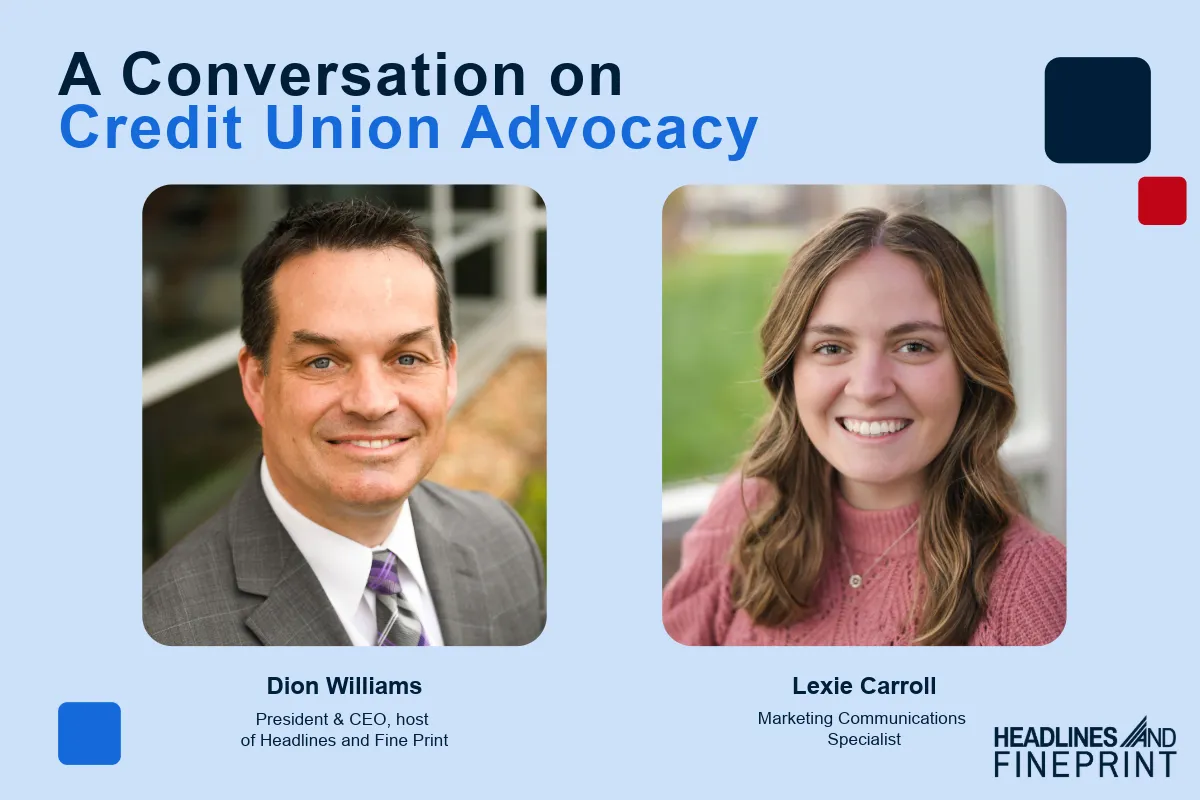
In this episode of Headlines and Fine Print, Piedmont Advantage President & CEO Dion Williams sits down with Marketing Communications Specialist Lexie Carroll to discuss current credit union-related legislation, advocacy and the importance of helping lawmakers understand the credit union difference.
How Did You Become Interested in Legislative Affairs?
Lexie: I’ve always had an interest in legislation, but when I started here in this position, I didn’t really see how those two things could go together. Through the help of my manager, who mentioned your involvement with the Carolinas Credit Union League and working with them, I was like, ” Oh, that would be kind of cool to shadow and kind of experience that, because I think I’ve always had an interest in it.”
Through learning more about it and what it looks like, I can now see the correlation, because marketing is very focused on storytelling and showing people the purpose of credit unions and our goals. That’s a big part of lobbying, too: getting those elected officials to understand our goals and, in turn, push legislation that will help us.
We recently attended the Carolinas Credit Unions League State House Day. How Would You Describe That Experience?
Lexie: It was such an awesome experience. Shout out to Carolina’s Credit Union League. That was a cool experience for me, especially since it got my feet wet.
There were a lot of people who had been very involved in this stuff for years. It was not only cool to see all these important figures and credit unions come together to work on something that aligned with their beliefs, but also to sit down and speak with some elected officials. We got to hear their understanding of credit unions, the legislation currently being worked on to support credit unions and their missions, and their support for it. I know that sometimes legislation and governmental affairs can seem like an uphill battle, and that everything moves slowly, but being there and seeing how things work, you can’t help but feel inspired about the future.
What Was Your Biggest Takeaway?
Lexie: Honestly, it lit a fire in my belly. I know that I want to keep pursuing something like this. Participating in State House Day made me realize this is something I do want to pursue and keep exploring, whether it’s in my actual day-to-day job or just something I get to do on the side. I feel like a lot of people going about their lives don’t really see what happens behind the scenes in government. We often think things happen or that we don’t have any control over what happens, but these are elected officials there to serve our purposes.
It was cool to see that they are listening. They are willing to take the time and hear what people have to say. Your voice has a purpose. Once you find something you’re passionate about, there are ways to get involved, work on it or support legislation that supports our communities.
Dion: That’s fantastic. Earlier in my career, I had similar interests. My wife always said, “You know, not going to let you go into politics because the whole family gets dragged into its kind of thing.” But I found my place in the world to be active in it through credit unions, because, generally, no matter what side of the aisle you’re on, credit unions are a popular topic: we do good things in the communities and help folks.
The thing that I had to learn, being my impatient self, is that sometimes the best offense is a good defense. We did a podcast last year on the Big Beautiful Bill and were worried there might be some takeaways for credit unions. Thankfully, that didn’t happen because of the relationships credit unions had established.
On State House Day, we weren’t really asking for anything. It was just more of a this is who we are, and this is what we do. There is legislation we’re hoping the state will pass, because the last time the Credit Union Act was updated was in North Carolina. I don’t believe either of us was born yet. It’s kind of in need of an update, but you form those relationships for that purpose.
Was There Anything That Day That Surprised or Interested You?
Lexie: I wouldn’t say it necessarily surprised me, because with my background, I understand how busy these people are. However, I would say the most interesting part of it was how quickly we had to move. A lot of the time, we were running around trying to catch someone, and we would miss them or only be able to talk to them for five minutes.
Even still, I think it was nice enough that even if they only had 30 seconds, they took the time to hear at least what we had to say. So that was probably…I was expecting it, but I wasn’t. But I thought that was an interesting part.
If You Could Come Up with a Piece of Credit Union Legislation That Could Change How We Do Business for the Better, What Would That Be?
Lexie: That is a great question. The answer that comes to my mind instinctually. I feel bad because I’m not coming up with it. It’s part of the legislation they’re working on now. It would be that credit unions could have more wiggle room in the areas they serve, because there are many banking deserts where banks are pulling out, and credit unions, because of legislation and red tape, can’t go into those communities to serve them.
That would be something I would really push for. It’s good to have set boundaries for where credit unions can and can’t go. I see the reason behind that. But I also think that if a community is underserved and there are people there who are financially restricted, let credit unions come in. You know what we stand for. You know our values, and you know we’re coming in to help them.
Dion: That is absolutely a centerpiece of the legislation. Great answer. We’re hoping that goes through because it’s currently in conference with a different bill, which is not uncommon in the political system: different ideas come together in one bill.
But we’ll keep an eye on that during the short session.
Do You Have Any Questions about My Experiences or the Political Process That I Have Gone Through?
Lexie: What kind of advice would you give to someone who’s trying to pursue or get into lobbying?
Dion: The first part depends on whether you’re a credit union professional. We have chapters throughout the Carolinas, and that’s where you’ll hear some things come up. But you can also research the Carolinas Credit Union League website, and there are national websites as well, such as CU Insight and the CU Times.
They have kinds of issues of the day. I would say one thing is just kind of awareness of what’s going on. Because during the big, beautiful bill, it was the tax exemption.
Just in case any bankers are watching today, credit unions pay all kinds of taxes. We have a federal income tax exemption, but we’re a not-for-profit. We give our members money back. That’s why that exemption is both deserved and earned in real-life practice. But that’s just an education on the issues.
When I was first starting in credit unions, and this was in, I’m going to say 1997, I was on a bus, I was working for Local Government Federal Credit Union at the time, where credit unions from all over the state went up to Washington, DC, because that was for House Bill 1151. That’s when a Supreme Court case challenged the field-of-membership rule. Then Congress took action to allow the expanded field of membership. Every state in the country was there.
Congress acted, and the president signed it into law. That was so early in my career that it made a lasting impression on me: how great this is. The emails, the phone calls and the in-person visits, they do matter.
Final Thoughts
Lexie: Your voice matters, and we care about the work we’re doing in our communities. That’s why, behind the scenes and in front, people at your credit union are working to make sure that legislation helps credit unions pass, so we can offer you the best services and be there to support our communities.
Dion: That’s an excellent takeaway. Again, as we kicked off the podcast, we talked about cooperation among cooperatives. There were literally dozens of credit unions participating in State House Day. Earlier, I referenced a DC trip, and South Carolina had a State House Day a couple of months ago. This is really about credit unions coming together to tell our story and the good things we’re doing in the communities we serve.
Catch Us Next Time on Headlines and Fine Print
We’re going to have a series of guest hosts in the coming months to bring you more education like this. Want to listen to past episodes? Check out our Spotify and YouTube.
In the meantime, know that we’re here looking beyond the headlines into the fine print so members can get the information they need to be well-informed financial consumers.
Keep reading below for more insight into this episode’s guest, Lexie Carroll.
What Character in Entertainment Have You Drawn Inspiration from Related to Your Field?
Lexie: Anyone who knows me knows that I am a huge Parks and Recreation fan, and therefore, I love Leslie Knope. She has always been an icon for me, and a lot of what she does doesn’t really align with my day-to-day job, but I’ve always been interested in government affairs, so I enjoy that side of it.
Overall, her determination, drive, and ongoing optimism in always accomplishing her goals have always really inspired me. That’s always something I’ve looked up to. Fun fact: I was on my high school newspaper staff, and one thing we always did was decorate our little laptops with a female icon or character we looked up to, and mine was Leslie Knope.
I had pictures of her all over my laptop, so she always inspired me to keep moving and accomplish whatever goals I had.
About Our Guest
Lexie joined Piedmont Advantage’s Marketing department in October 2024. She has years of experience in communications, journalism and marketing. This position is her first at a financial institution. With a journalism background, Lexie thoroughly enjoys storytelling, whether that be through written communications, marketing or conversations.
Related Resources
-

Simplify Your Savings
Everyone knows how important saving money is, but oftentimes, life gets in the way. Unexpected expenses, such as car repairs, medical bills and the overwhelming feeling of managing your budget, can derail our intentions to save money. By the end of the month, adding money to your savings becomes too easy to skip. However, there
-

Stay Up to Date as We Move Forward Together
It’s official! Piedmont Advantage is merging with Truliant Federal Credit Union. We are approaching this next chapter with care for you, our employees, and the communities we serve. Together, we will be able to offer broader access through more branches and ATMs, enhanced technology, and expanded services, while continuing the personal relationships that define us.
-
The 50th and Final Episode
By Dion Williams, President & CEO, Piedmont Advantage 50 episodes. It’s hard to believe that I have been hosting Headlines and Fine Print for that long. Time really does fly. Many of you may not know that when it began, it was a radio segment on WSJS with Jeffrey Griffin. Then in 2023, we switched
-

Auto Loans and You
Buying a new car is exciting. It’s also one of the biggest purchases most people will make. Unless you pay with cash, an auto loan will most likely be part of the journey. The good news is that the right loan can help keep your monthly payment manageable while making it easier to drive away
Looking for More Insights?
Read the latest financial literacy blogs to learn more about sticking to a budget, managing risks, navigating trends and more!
